
DAvid Linneweh
BFA Painting ’02
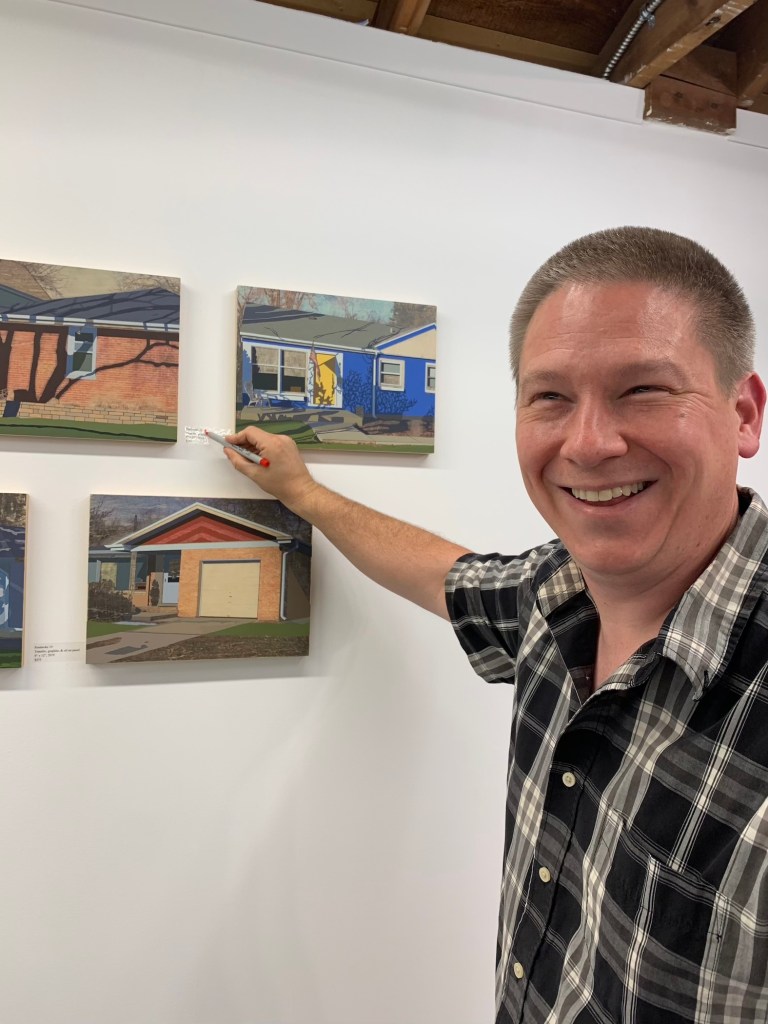
A Trial by Fire: Awakening the Artist Within
“I had to make 30 paintings in five days.” David Linneweh recalls this moment at a summer residency in Chautauqua, New York, with a mixture of humor and reverence. That intensive experience, forged during his time as a student at Illinois State University (ISU), would ignite a passion that reshaped his artistic life.
Originally from Roselle, Illinois, Linneweh grew up surrounded by the suburban landscapes that would later deeply inform his painting practice. Graduating with a BFA in painting from ISU in 2002, his early college years were marked by challenges. “I was on academic probation my first year,” he admits. Despite setbacks, these experiences laid the foundation for the work ethic and authenticity that define his career today.
Finding a Path Through ISU
Linneweh’s artistic journey didn’t unfold neatly. “I didn’t have immediate success,” he says. Grappling with coursework, navigating a rigorous BFA program, and battling self-doubt, he slowly found his footing. Professors like Shona MacDonald and L.J. Douglas were pivotal in his development of color and content.
At ISU, abstraction reigned. Representational work was rare, making Linneweh’s eventual direction even more striking. “There was no push for people working representationally at all,” he explains. Yet these early experiments with color, form, and imagined landscapes led him toward a hybrid visual language, blending observation with a deep conceptual foundation.
Interestingly, Linneweh didn’t see his landscapes as straightforward representations. “My BFA show was kind of about imagined spaces—weird Western oases or Antarctic places—but all through this lens of abstraction and color fields,” he shares. This blend of imagination and environment would become a hallmark of his later work.
Building Momentum: From Kitchen Studios to Galleries
After ISU, Linneweh took a year off before pursuing graduate school, working out of the small kitchen in his apartment. “It sucked,” he laughs, but those modest beginnings were crucial. Painting at the kitchen table, submitting to open calls, and landing shows like New American Paintings fueled his momentum.
Working at Hobby Lobby during this period also exposed him daily to the rapid suburban development outside his window—a new visual and thematic fixation. “Seeing homes constructed from scratch made me think differently about space, place, and memory,” he reflects. These observations would become core themes in his paintings, where open landscapes and suburban structures intertwine.
Over time, his paintings evolved to feel increasingly rooted in real-world observation, yet always carrying the traces of abstraction and conceptual inquiry. Linneweh points to his time spent photographing new developments as pivotal. “You see a neighborhood before it’s even a neighborhood. It’s just geometry, raw lines and space.”
This attention to the “bones” of a landscape continues to shape his studio practice today.
Embracing Multiple Roles: Artist, Teacher, Podcaster, Gallerist
Today, Linneweh wears many hats: professor, artist, gallery owner, and podcaster. Each role feeds the others, creating a dynamic, interconnected practice.
Teaching at College of DuPage and College of Lake County since 2009 has honed his observational skills and expanded his toolkit. “When I started teaching, I was obsessed with being conceptual enough,” he says. “Now I realize my specialization—what I uniquely bring—is what matters.”
Navigating the challenges of teaching in higher education, particularly as an adjunct, has also informed his perspective on sustainability within the arts. “You can’t just do one thing,” he cautions. “You have to piece it together from different avenues.”
His podcast, Studio Break, launched in 2011, emerged naturally from his passion for talking to artists. “I’ve never been a great book-research artist. Conversations fuel me,” he explains. Podcasting deepened his understanding of artistic practice and offered a platform to spotlight emerging voices. Through over a decade of interviews, Linneweh has created a vibrant archive of contemporary artist conversations.
Opening his gallery space, Studio Break Gallery, in 2022 in West Chicago was a further extension of this ethos. “It lets me foster community, highlight work I’m passionate about, and create opportunities for others,” he says. The gallery has quickly become a hub for new connections, featuring both regional artists and broader national talents.
Lessons Learned and Advice for Emerging Artists
Reflecting on his own path, Linneweh is candid about the realities of sustaining an art career. “The idea of just doing one thing is really impossible,” he says. Teaching, podcasting, exhibiting—all these pursuits create a more stable, fulfilling ecosystem.
He encourages young artists to broaden their understanding of what a creative life can look like. “Think about administration, community outreach, or teaching workshops. There’s no one path.”
Above all, authenticity is key. “Be yourself,” he stresses. “Your specialization is your strength.”
He also emphasizes the importance of sharing opportunities within the artistic community. “A rising tide lifts all ships,” he notes. If he sees a teaching position or an open call, he’s quick to pass it along to friends and colleagues. “Artists don’t talk enough about lifting each other up.”
The Power of Community
Throughout our conversation, one theme recurs: community. Whether it’s supporting students, spotlighting fellow artists, or connecting dots between ISU alumni across the country, Linneweh believes deeply in collaboration.
“The world is smaller than people realize,” he says. In one memorable instance, a student recognized a house he painted—it belonged to her boyfriend’s family. These chance connections reinforce the profound ways place and memory intertwine.
Linneweh’s involvement in Normal Roots, ISU alumni exhibitions, and Studio Break interviews continues to foster a sense of shared experience and mutual support.
“Seeing artists succeed, especially those you’ve talked to early on in their careers, that’s the best part,” he shares.
Looking Ahead: Longevity Over Hype
Today, Linneweh measures success differently than he once did. “It’s about longevity now,” he says. “Early on, you think being in a show or a magazine means you’ve made it. But real success is being able to keep making work you care about, year after year.”
He emphasizes the importance of patience. “A lot of good things come from sticking it out,” he says. “There are no shortcuts.”
Future goals include expanding his gallery program, growing Studio Break, and finding ways to integrate more in-person visits and interviews. “Traveling for studio visits, seeing the spaces where artists work, that’s what excites me,” he says.
Even as he juggles roles, Linneweh’s creative practice remains at the center. “I’m painting again with a new sense of clarity,” he says. “After years of balancing other projects, it feels like the work is finally clicking into place.”
His story is a powerful reminder that artistic careers aren’t linear—they are built moment by moment, connection by connection, with persistence, humility, and a genuine love for the process.
Interview by Kelsey DeGreef for Normal Roots.
 Normal Roots