
DAvid Wilson
MFA Painting ’01
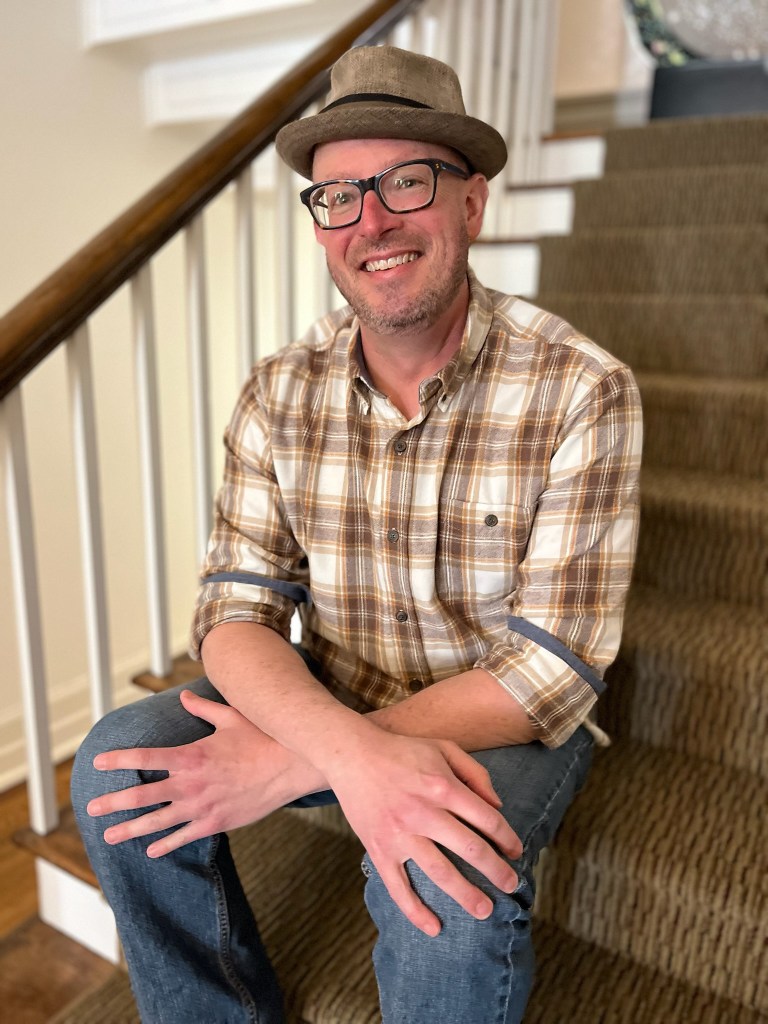
More Than One Way Forward: Teaching, Curating, Creating
When David Wilson reflects on hisjourney through the art world—from sketching during long days inside as a child to curating exhibitions that give voice to cancer survivors—he speaks with a grounded wisdom shaped by decades of navigating uncertainty. “I’ve had a taste of almost everything in my career,” he says. “Curator, administrator, teacher… I’ve taught every level from 4th grade to someone in their 70s.”
David’s story is shaped by persistence, mentorship, and a willingness to move forward even when the next step wasn’t obvious. Across jobs, states, and disciplines, David has carved out a life that values impact over prestige and process over certainty. His career is a reminder that being an artist isn’t about following a fixed plan—it’s about paying attention, building relationships, and staying open to change.
Drawing in the Margins: A Childhood Spark
David traces his earliest connection to art to a period of illness during his childhood in Lockport, Illinois. Recalling those quiet hours, he says simply, “A lot of my indoor time was drawing.” Encouraged by family and inspired by public television icons like Bob Ross and Bill Alexander, he began to see art as both a refuge and a realm of possibility. “Those two artists proved to anybody at home that you could pick up a brush and move it around with paint… and make it look like something.”
By high school, that early interest had sharpened into real talent. Winning art awards and building confidence, he continued into junior college, where everything changed under the mentorship of Joe Milosevich. “He was the first true mentor of my life,” David says. “He showed us what it really takes to make art—not just as a hobby, but as something demanding and rigorous, just like chemistry or algebra. I respected that.”
Joe’s influence would echo throughout David’s journey, not just in the studio, but in the kind of educator and mentor he would later become.
“What’s Grad School?”: A Nudge Toward ISU
After transferring to Columbia College Chicago, David was immersed in the vibrant, alternative energy of the city’s late-‘90s arts scene. It was there that another pivotal mentor, painter and professor McArthur Binion, made a suggestion that would steer David toward Illinois State University. “I was painting a large piece of Red Skelton—celebrities still factor into my work even today—and McArthur just comes up to me and asks, ‘You ever think about grad school?’ I told him, ‘What’s grad school?’”
The answer came quickly. McArthur walked David back to his office, arranged a call with ISU’s Jim Lutes, and within days David was driving to Bloomington-Normal to tour the graduate studios. He was initially denied admission—but unbeknownst to him, a former professor intervened. “Nancy Stewart, my art history professor at junior college, had studied at ISU. She called Harold Boyd and ripped him a new one,” David laughs. “She said, ‘How could you not talk to this kid?’ Next thing I know, I get a call: ‘Expect a letter. You’ve been accepted.’”
David graduated from ISU with his MFA in 2001 and began teaching immediately. He cobbled together three different teaching gigs that fall—seventh grade in Leroy, a life drawing class at ISU, and night courses in Joliet—commuting across the state to make it work. Then came September 11.
“We were in the cafeteria when the custodian came in and said a plane had hit one of the towers,” he recalls. “I drove to ISU for my next class, listening to NPR. The second plane hit. That day changed everything.”
When he entered his life drawing classroom, he offered his students the option to leave. “They said unanimously: ‘We want to work.’ That moment sobered me. It was the quickest divorce from being a student. You realize your role, your responsibility. I felt like a peer for the first time.”
The Patchwork Years: Teaching, Applying, Surviving
Like many early-career artists, David spent the years following grad school balancing multiple adjunct roles while applying to permanent positions—sending out 70 applications in one season alone. He jokes about the smell of developing fluid still lingering on the 35mm slides he used to submit his work. “This was the old school days,” he says.
Eventually, he secured a position at Black Hills State University in South Dakota, where he stayed for more than a decade and made full professor. But over time, he began to feel restless. “I don’t want to retire yet. I’m goal-oriented. I kept asking, ‘What’s next?’”
What came next was a leap—leaving his tenured role, moving to Oregon, and embracing uncertainty.
Reinvention on the West Coast
The Pacific Northwest proved to be more than a change of scenery—it was a turning point. David took a position as head curator at the Salem Art Association and began teaching community education classes at Oregon Coast Community College. He also discovered something rare and powerful: a thriving, deeply connected art community. “Within one month of moving, I had five group shows to be part of. I’d never had that anywhere else—Illinois, South Dakota, even now in Nashville.”
This sense of belonging and opportunity left a lasting impression. “The Pacific Northwest gave me something no other place I’ve lived has offered. It’s a place where the arts are woven into the community.” He embraced curating as a deliberate pivot. “People told me, ‘Take a break from academia. Do something that gives you space to make art again.’ I’d been installing shows for years unofficially, and this was a chance to do it professionally.”
Pandemic Pivots and the Road to Vanderbilt
The pandemic reshaped David’s work once again. When the Art Association closed to the public and uncertainty loomed, he pivoted to a role at a community college in Kentucky. There, he juggled nine courses a semester, managed the campus gallery, and navigated the steep learning curve of remote instruction—all in a region with limited creative infrastructure. “It was overwhelming,” he says. “My health was going downhill.” The role may not have been sustainable, but it added another layer to his experience: what it takes to lead through constraint, and how to keep your creative instincts alive under pressure.
In 2023, a new opportunity opened up at Vanderbilt University’s Curb Center for Art, Enterprise & Public Policy, and David seized it. Now in his third year there, he serves as program coordinator, managing gallery installations, finances, and collaborations with community organizations like Gilda’s Club of Nashville.
One recent exhibition brought together expressive writing from the Vanderbilt Ingram Cancer Center with visual art from Gilda’s Club members, illuminating the emotional and communal realities of cancer. “It wasn’t about therapy—it was about awareness, storytelling, humanity. The artwork didn’t scream ‘cancer,’ but it unfolded the more time you spent with it.”
David also teaches a watercolor class through Vanderbilt’s community education program, continuing his thread of public engagement.
“Still Teaching”: The Curator as Educator
Even in curatorial roles, David’s teaching instincts persist. He speaks with pride about creating hands-on workshops for fourth graders at the Salem Art Association and helping students in Owensboro rebuild a campus gallery from scratch. “Everything that was done successfully there was done as a team,” he says.
For David, the heart of art is connection—and leadership means lifting others up, just as his mentors once did for him. “That’s what I try to infuse. Not replicate, but channel. When the moment’s right, I want to be that person who helps, who sees potential, who builds something lasting.”
Looking Ahead: Art, Community, and the Long Game
As David approaches his 50th birthday, he’s thinking long-term. “I probably have 20 more years in me.” He’s choosy now, not just about roles, but about place. It is important to him to be somewhere with a strong community arts network. He dreams of starting something one day with his best friend Chad—a kind of artist’s retreat-meets-bed-and-breakfast. “A place where people could immerse themselves in art for a weekend. Where you offer lessons, host shows, build community. We’ve joked about it for years.”
And he still draws fuel from those who’ve inspired him—from mentors like Joe Milosevich and Uncle Bob at ISU, to colleagues like John Shartung in Kentucky, who earned his MFA at nearly 80 before passing away. “He was making art every day. That’s the kind of drive I admire.”
Advice to Emerging Artists: Make Money, Make Time, Make Art
Asked what he’d tell today’s graduates, David doesn’t hesitate. “Don’t be afraid to accept a job that makes you money. If you don’t have a cushion, get what you need to live—but make sure it leaves time to create.” He knows firsthand that piecing things together is often part of the path. “There’s no shame in working a side job or doing something outside your field. Just protect your studio time like it’s sacred.”
And perhaps most importantly: build community. David’s journey is proof that connection, not just credentials, makes the difference. “You never know who’s going to call someone on your behalf. You never know who’s watching your work, who’s going to open a door, who’s going to show you who you can become.”
Rooted in Experience, Growing Forward
David Wilson’s path reflects what Normal Roots is all about: staying connected to the people and places that shaped you, even as your work—and your life—evolves. From ISU to Oregon, from classroom to gallery, from making to mentoring, David has never stopped building community through art.
For current students and recent graduates, his story is more than inspiring—it’s instructive. It shows that there’s no single way to build a career in the arts, and that success often comes from staying adaptable, staying in touch, and staying grounded in what matters most: your practice, your people, and your purpose.
“I think we all hit a moment where we have to ask: What am I doing, and why?” David says. His story doesn’t offer easy answers—but it does offer encouragement, direction, and proof that you can keep moving, keep making, and keep showing up for yourself and for others.
Interview by Kelsey DeGreef for Normal Roots.
 Normal Roots