Gina Hunt
MFA Painting ’15
Aliveness in the Layers: Gina Hunt on Light, Perception, and the Material Life of Painting
When Gina Hunt talks about painting, she’s not just talking about color on canvas. She’s talking about light, time, perception, and the body. She’s talking about quilting with her grandmother, cyanotypes in the grad studio closet, and the geometry of twilight. Her work resists boundaries, and so does the way she speaks about it.
“Painting is not an image anymore,” Gina says. “It’s an object. It’s a spatial thing.”
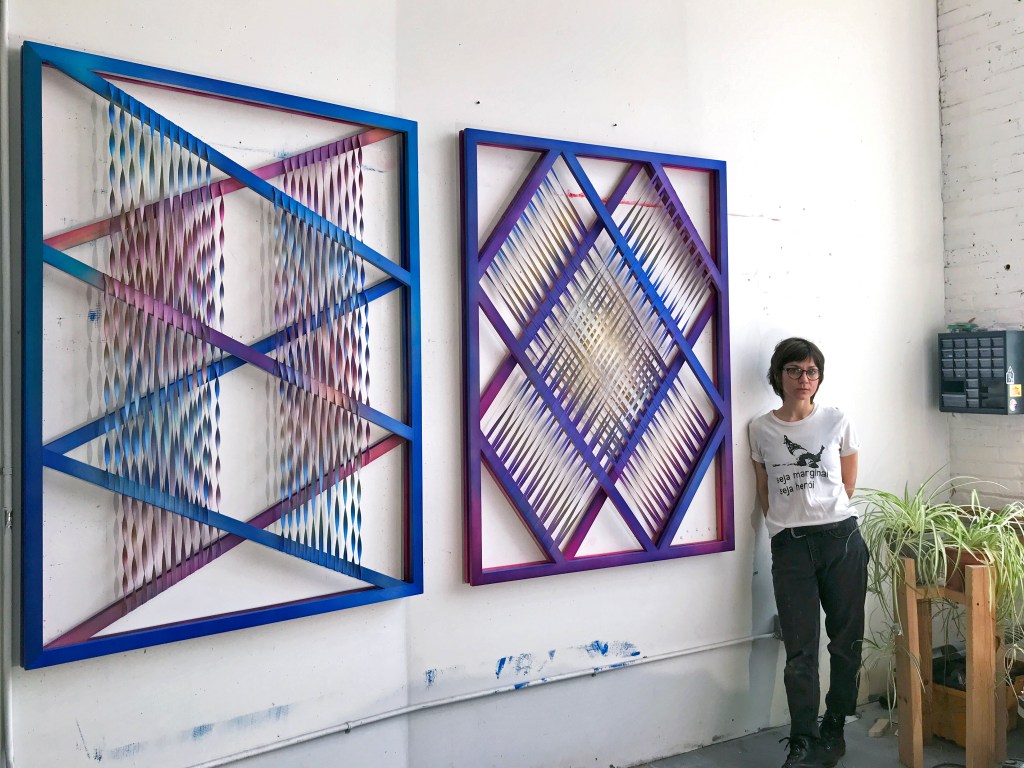
That idea — painting as object, as something to move around and interact with, as something alive and changing depending on your perspective — has guided Gina’s evolution from traditional printmaking and painting toward increasingly sculptural and conceptually layered works. Through it all, she’s stayed rooted in material exploration, curiosity, and an unapologetic desire to shake people awake.
Early Drawings and South Dakota Skies
Gina’s creative life started early. “My earliest memories are of the power of making a drawn line,” she recalls. As a child growing up in South Dakota, she was drawn to art as both a solitary practice and a form of agency. She remembers preferring stamps and drawing tools to playground games, and by high school, she was already carving out studio space in the back of the art room.
Supported by parents who valued music and art, Gina immersed herself in creative outlets—from symphonic cello to analog photography. “We had a supportive art teacher in high school. I took every art class available,” she says. “When I graduated, most of those classes were cut. I got in just in time.”
She completed her BFA at Minnesota State University, Mankato, concentrating in both painting and printmaking, and minoring in art history. That grounding in materiality and mediation—the process between hand and image—would become central to her future work.
The Shift Begins: Cyanotypes and Conceptual Light
When Gina began her MFA at Illinois State University in 2012, she was still rooted in painting, but she was already pulling at the edges of what that meant. Inspired by Roland Barthes’ Camera Lucida, she became captivated by the conceptual potential of light. “Barthes talks about the photograph offering this vertigo of time. That ‘this has been.’ That really stuck with me,” she explains.
She taught herself to make cyanotypes—a camera-less photographic process—and built a makeshift darkroom in her studio closet. She’d coat paper, run outside into the sunlight, and watch images emerge from light exposure. It was process-heavy, deeply physical, and ephemeral all at once.
Fontana’s slashed canvases also made an impact. Gina began considering paintings as spatial objects, not just surfaces for images. “I was folding canvas, spraying paint, and thinking of the mist of paint as light itself,” she says. The process became an analogy: spraying as exposure, color as wavelength, and canvas as textile.
A Quilt, a Risk, a Breakthrough
Midway through the program, a pivotal moment came. Gina returned home and made a quilt with her grandmother. It changed everything. “We stitched squares, cut them, reassembled them. The patterns reminded me of American abstraction, but also carried these quiet, powerful histories outside the canon,” she says.
Back at school, she looked under her table at a stack of failed, unstretched paintings. “I said, fuck it. I’m gonna cut these up.’”
It was risky. It was manual. It was exactly what she needed.
“I had no idea what I was doing, but I knew I needed to move the material with my body,” she says. From there, her work began incorporating layered fragments, quilt-like constructions, and increasingly three-dimensional forms. She was still painting, but the boundaries were dissolving. “People would say, ‘How do you call that a painting?’ And I’d say, ‘Let’s talk about that.’”
Painting as Perception: Wonder, Seduction, and the Lack of Finality
Gina resists the idea of closure in her work. “I’m not after a conclusion,” she says. “I want to stay in the space of questioning.”
She explores perception and vision not just metaphorically but through research into optics, human vision, and spectral data. Light isn’t just a visual effect—it’s the very subject. The way her work changes as viewers move around it is intentional. “People assume vision is objective, but it’s not. We don’t see things the same way.”
That instability—that refusal to stay still—is part of what drives her. “I want the work to seduce people. Arrest their attention. Remind them they’re alive.”
She admits that desire felt shameful at first. But she now embraces it. “We only get a few seconds of someone looking at our work. I want to make those seconds count.”
Energy, Vibration, and the Color of Air
In recent projects, Gina has explored the concept of twilight—the liminal color shift after the sun has set but before the dark. “You’re seeing the color of air,” she says. Through research into atmospheric optics and physicists’ data visualizations, she finds new ways to approach color, light, and spatial experience.
“I believe everything holds energy,” she adds. “Energy can’t be created or destroyed. So it’s always moving.”
That movement, that vibration, finds its way into her layered constructions. Whether referencing the geometry of light, the history of quilting, or the folds of failed paintings reborn as sculpture, Gina’s work hums with presence.
From ISU to Chicago: Staying in Motion
After graduating from ISU in 2015, Gina moved through a series of artist residencies before settling in Chicago. She now teaches painting and continues to exhibit, including a recent show at 65GRAND.
What keeps her going is a deep commitment to curiosity. “If I decide to be an artist, I can learn about whatever I want. That was a big realization for me.”
And though her work has shifted dramatically from her early days, her intentions remain the same: to explore the materiality of experience, to stretch painting beyond its limits, and to remind us that light, like perception, is always in motion.
“Painting still has so much potential,” she says. “And I just want people to remember what it feels like to really see.”
Interview by Kelsey DeGreef for Normal Roots.
 Normal Roots