
Mel Cook
MFA Painting ’12
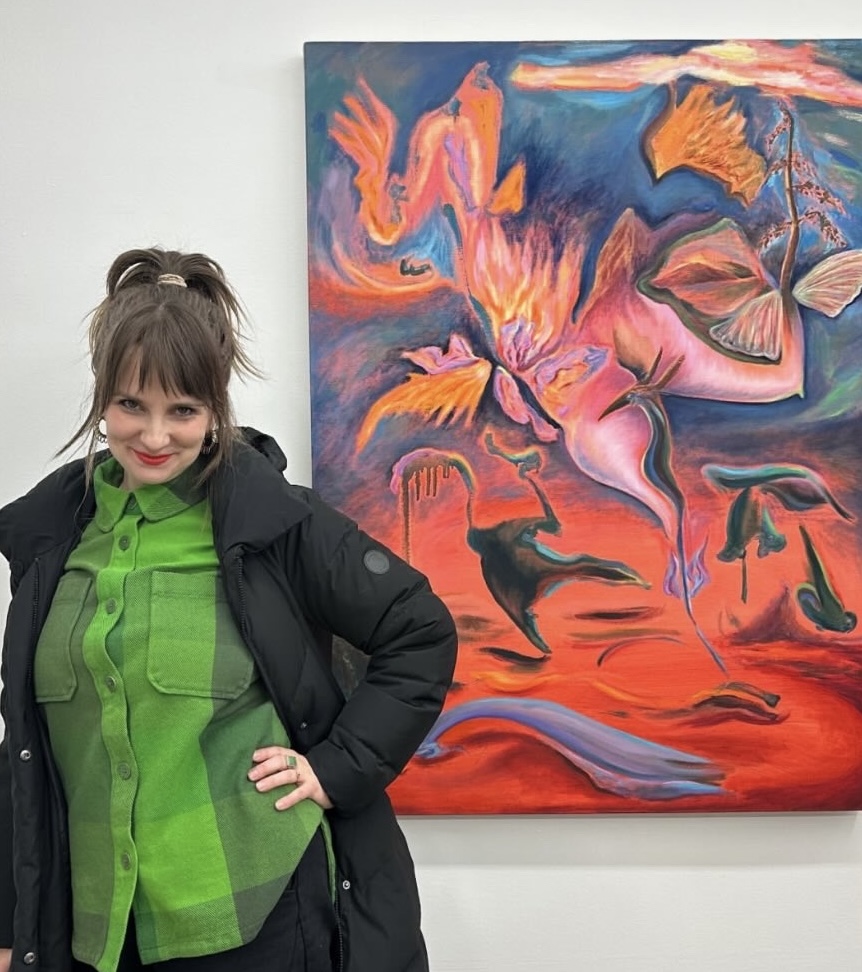
Making Through Motherhood and Myth
Some artists come to their practice gradually. For Mel Cook, it started at five years old, standing in front of a Van Gogh painting in a Cleveland museum. “There was just such an energy that I had never really felt before,” she remembers. That spark never left. It only deepened. Cook, a painter and teaching artist based in Chicago, has spent over a decade weaving her identity as a maker, educator, and now mother. Her work—layered, meditative, and rooted in histories of the body, labor, and language—resists easy categories. And that, it turns out, is exactly the point.
Early Foundations
Raised in rural Ohio, Cook was lucky. Her public schools had strong arts programming, and her teachers saw her potential early. But while the support was there, the models weren’t. “I didn’t know where I fit in,” she says, recalling the overwhelmingly white, male art history narratives she encountered.
Initially, she considered teaching K–12 art. That changed during her BFA studies at Bowling Green State University, where she focused on printmaking and painting. “I realized I definitely didn’t want to be a K–12 teacher, but I did want to teach art,” she says. The rigid structures of traditional classrooms didn’t appeal to her, but she was drawn to the creative energy of teaching in less conventional spaces. That realization led her to pursue an MFA in painting at Illinois State University, where she graduated in 2012.
Finding Her Educational Home
After ISU, Cook’s path took her through a variety of creative and educational roles in Chicago. She interned at the Museum of Contemporary Art in the School and Teacher Programs, briefly considered museum education, and taught at Chicago High School for the Arts. She also participated in the Center Program at Hyde Park Art Center, which she credits with helping her connect more deeply with the local art community. Alongside this, she taught as adjunct faculty at the Northwestern University before fully transitioning into community-based education. “It took me a while to find my educational home,” she says, reflecting on the years of exploration that preceded her current role.
Today, Cook teaches part-time at Marwen, a nonprofit that provides free visual arts education to students from under-resourced communities. She works with students from middle school through high school. “I love working with kids,” she says. “But teaching full-time in a traditional school setting just wasn’t sustainable for me, emotionally or creatively. The structure at Marwen gives me the best of both worlds: I get to teach students who want to be there, and I still have time for my studio.”
She also tried stepping away. Burned out by pandemic teaching, Cook spent a year and a half in advertising and copywriting. It didn’t stick. “I can’t be in the corporate world. I’m just not built for it,” she says. “It was soul-draining.”
Life Shifts And Long-Standing Interests
Motherhood has reshaped Mel Cook’s practice in profound ways. After the birth of her daughter, she moved her studio home and began working in short bursts, carving out time between moments of caretaking. “My practice isn’t an 8-hour block anymore,” she says. “It’s all the time.”
That shift didn’t change her focus so much as deepen it. Her recent work continues a long-standing interest in the body—especially the female body as both image and object, and the paradoxes embedded in that duality. “There’s this weird pedestal of perfection,” she says, “and also this angst and violence towards mothers.”
Long before she became a parent, Cook was already researching histories of reproductive labor and control. Sylvia Federici’s Caliban and the Witch became a foundational text for her thinking, helping her trace the links between midwifery, femicide, and the politics of bodily autonomy. These themes—resistance, vulnerability, and power—continue to shape her work.
In recent years, language has emerged as a key thread. Many of Cook’s latest drawings began as meditations on inaudible speech and early vocalizations. “Now that my daughter is learning to talk, I’m hyper-aware of how language shapes our understanding of the world,” she says. Her work also interrogates the binaries that language creates and sustains—mother vs. crone, craft vs. art, pink vs. red. “Pink is red,” she jokes. “It just has white in it.”
This body of drawings may eventually take the form of a book. “They emerged through a quiet, intuitive process,” she says. “There’s something about narrative and sequence that I’m interested in exploring.” For Cook, the act of making is inseparable from the act of questioning, and her evolving practice reflects a life lived in constant conversation with both history and the present moment.
Community And Relentless Adaptability
Keeping a practice alive post-graduation is no small feat. Cook credits two things: community and relentless adaptability. When she moved to Chicago, she didn’t know many people. So she cold messaged artists on Instagram to ask for studio visits. “That helped keep the fire going,” she says. “Eventually, it became so ingrained that when I don’t make work, I feel weird. I don’t feel healthy.”
She compares the lifestyle to surfing: “You’re just riding waves. The older you get, the better you get at knowing when to paddle out and when to rest.”
Criticism And Misunderstandings
When asked what artists don’t talk about enough, Cook doesn’t hesitate: “Real criticism.” She misses the rigor of graduate critique and finds that in post-school life, honesty can be hard to come by. “People don’t want to be mean,” she says, “but growth requires critique.”
She also notes that people often misunderstand what making a living as an artist looks like. “I’ve never had a full-time job in my life,” she laughs. Instead, she cobbles together income from teaching, grants, exhibitions, and the occasional freelance gig. “Whatever pays the bills and still leaves room for the studio.” And while selling work is nice, it’s never the point. “If the work makes someone think differently, that’s success to me,” she says.
Advice For Emerging Artists
When it comes to advice for students on the verge of graduation, Cook recalls wisdom from a former mentor: Figure out where you want to live and build your practice there. “If you hate New York, don’t move to New York just because it’s the art capital,” she says. “You’re going to be miserable.”
She also emphasizes the importance of staying open and trusting your intuition. “All the best things in my life have come from risks. From just saying yes to things that felt right, even if they didn’t make sense on paper.”
A Practice That Evolves
Today, Cook continues teaching at Marwen, raising her daughter, and drawing in her home studio. The themes in her work—reproductive justice, power, vulnerability, language—keep evolving with her.
“I’m not someone who sits down and plans out a series,” she says. “The work comes from a weird, exploratory place. Only after I make it do I start to understand what it’s about.” That fluidity, that willingness to follow instinct over expectation, is what gives Cook’s practice its depth. Her work doesn’t just reflect her life—it is her life, woven through sleepless nights and years of determined persistence.
And for the artists following in her footsteps, she has this to say: “Travel, take risks, stay curious. If you want to keep making work, you have to keep feeding it.”
Interview by Kelsey DeGreef for Normal Roots.
 Normal Roots