
MElissa JOhnson
Professor, Art History & Visual Culture: Faculty since 2004
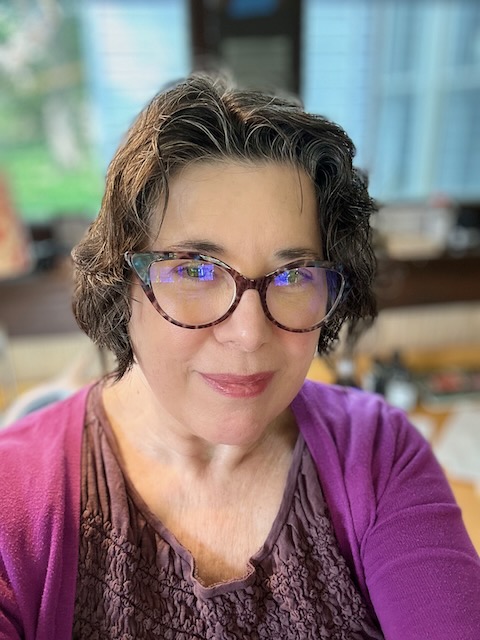
A Childhood In Museums Turns Into A Lifelong Pursuit
For Dr. Melissa Johnson, the journey to becoming an art history professor at Illinois State University didn’t begin with a single defining moment or iconic work of art. Instead, it started with long car rides and museum visits. “We did a lot of traveling around the country,” she recalls, “and we would go to art museums all the time.” As a child, she spent Saturday mornings in art classes at the Toledo Museum of Art. Her parents would routinely show up an hour late to pick her up because Melissa wanted time to wander the galleries.
Choosing Between English and Art History
Despite this early connection to art, she started college as a music major at the University of Michigan, having grown serious about the clarinet. But it was an undergraduate course on Realism and Impressionism that quietly shifted her direction. “I loved it,” she says of that art history class. “The professor later asked me to do an independent study. I was floored. That was the moment I started to think, ‘I could actually do this. I could go to graduate school.’”
Although she considered pursuing a PhD in English—her other undergraduate major—Melissa ultimately chose art history. But first, she earned a Master of Library Science and began working as an archivist, a decision that was both practical and personally meaningful. “I worked at the University of Michigan and then Princeton,” she says. “I curated exhibitions, wrote catalogs, and supervised students. But I realized I didn’t just want to be preparing research materials for others. I wanted to do the research myself.” This clarity led her to Bryn Mawr College, where she pursued her PhD in art history while continuing to work in archives. During this time, she discovered the artist Hannah Höch, a German Dadaist whose work explored mechanized bodies—a theme that resonated with her growing academic interests.
Finding Her Voice in the Classroom
Teaching wasn’t always the end goal. For Melissa, it emerged organically. After relocating to Western Massachusetts with her partner, she finished her dissertation and began teaching at Greenfield Community College. “I hadn’t taught in grad school,” she says, “but I quickly realized how much I loved it. I found my voice in teaching.” Her early teaching experiences were diverse: adjunct roles at Hampshire College, University of Hartford, and even grading at Smith College. This varied background shaped her teaching philosophy. “I got to work with students from so many different kinds of schools,” she explains. “Community colleges, private schools, and state schools.
Curiosity as a Learning Outcome
Now a veteran educator at ISU, Melissa focuses on sparking intellectual curiosity. “I hope my students get more curious about art,” she says. “I want them to think about ideas, to write well, and to ask questions.” She encourages students to situate art within broader cultural and political contexts and not just memorize artist names and dates. She also hopes they develop the confidence to visit museums and continue learning outside of formal education.
Her large general education course, “Gender and Identity in Art and Visual Culture,” used to be taught in a lecture hall to 88 students. Today, she teaches it online, where students can engage more intimately with complex topics like race, gender, and queerness in art. “Strangely enough, it feels more intimate this way,” she notes. “Students are more willing to share their thoughts one-on-one.”
Blending Research and Artistic Practice
Melissa’s current research reflects a significant pivot. Around 2012, she began exploring contemporary artists who create work in response to Virginia Woolf. “I’d always loved Woolf,” she says. “So, I started exploring how artists, especially those working in textiles, are engaging with her writing.” This scholarly focus reawakened a childhood hobby: embroidery.
She began stitching on 4×4-inch squares of felt, creating abstracted patterns and designs that resonate with ideas in Woolf’s writing. At the same time, she began extracting phrases from an online concordance of Woolf’s work and typing them onto 4×4-inch squares of paper. These stitched and typewritten pieces now come together in an ongoing project: a hybrid commonplace book titled The book has somehow to be adapted to the body, a phrase drawn directly from Woolf.
Inspired by the tradition of collecting quotations and ideas, Melissa’s commonplace book brings text and textiles into conversation. “It started as a way to better understand the artists I was writing about,” she explains. “But it became much more than that. The process of stitching helped me read Woolf differently.”
Her creative work is deeply entwined with her academic scholarship. Melissa wrote an essay on Woolf and contemporary artists for the exhibition catalogue Strange Oscillations and Vibrations of Sympathy (University Galleries, 2017), and she has another forthcoming on Room, a play by SITI Company based on A Room of One’s Own. She’s currently writing about artists Ann Hamilton and Audra Wolowiec, both of whom engage with Woolf’s work in materially inventive ways.
Melissa teaches this approach—sometimes referred to as “research-creation,” a methodology that integrates artistic practice with scholarly inquiry—in her course Text and Textile. There, students read theory and criticism, explore the relationship between writing and making, and develop hybrid studio-research projects of their own.
Encouraging Students to Broaden Their Horizons
Melissa also urges students to venture beyond their comfort zones. “Leave Illinois,” she says. “Go explore. You can always come back. But go meet people from different parts of the country, different parts of the world.” For her, mobility has been central. From New Haven to Toledo, Ann Arbor to Princeton, and finally Bloomington-Normal, Melissa’s path has been shaped by movement and transition.
Advice for the Next Generation
Her advice to students is rooted in realism, resilience, and a deep love for learning. “Be brave,” she says. “Keep making. Keep reading. Be smart, strategize. Have a five-year plan, a ten-year plan—but know that it’ll change.” For Melissa Johnson, the unplanned turns and interdisciplinary detours weren’t setbacks; they were essential. And in the fusion of text and textile, research and making, she continues to model how curiosity can stitch together a career, one thoughtful thread at a time.
Interview by Kelsey DeGreef for Normal Roots.
 Normal Roots