
Sarah Eckstine
MFA Photography ’24
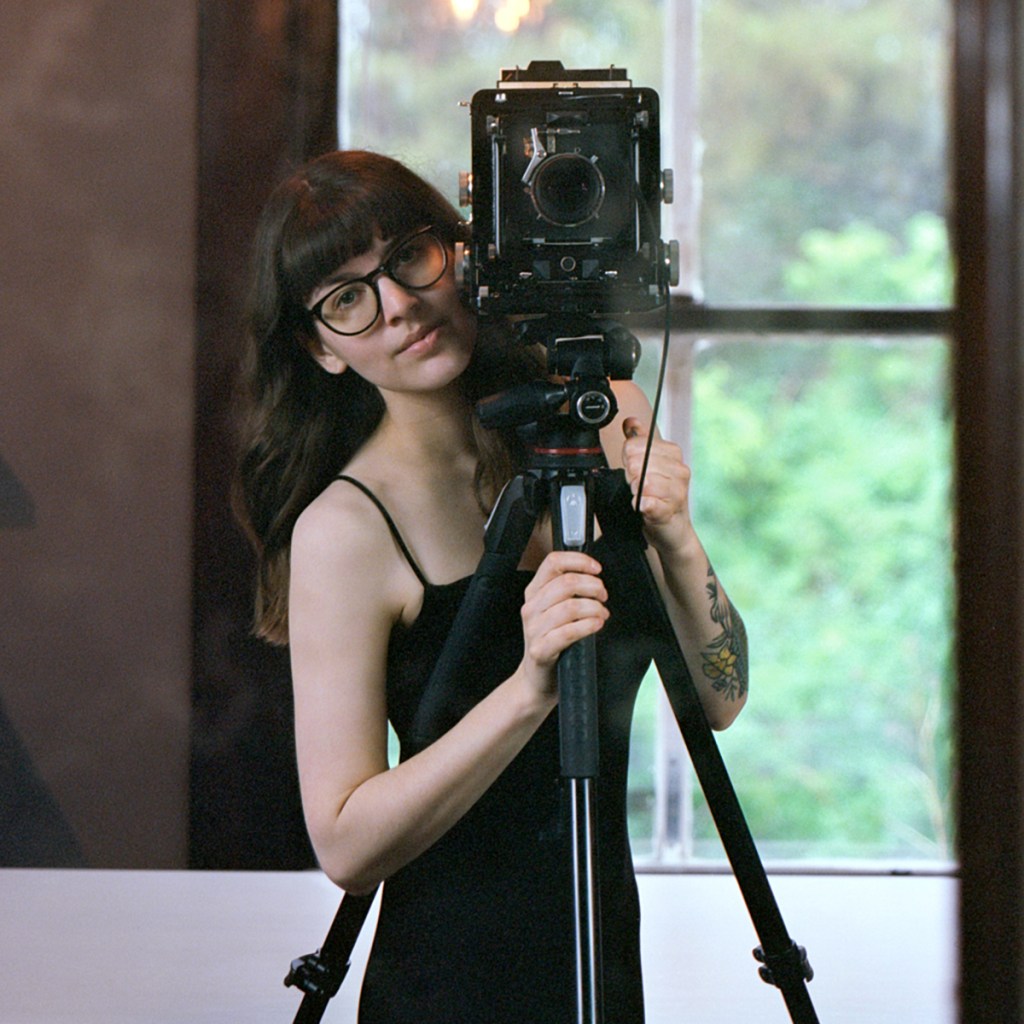
The Shape of What Hurts: Visualizing illness and reclaiming the body
When Sarah Eckstine was 21, she received a diagnosis that reshaped her body, her identity, and ultimately, her art. “I was angry. I was so mad,” she says. That fury, frustration, and search for understanding became the foundation of a photographic practice rooted in self-portraiture, advocacy, and visibility. Her work doesn’t just reflect her body; it reframes it. It doesn’t just depict pain; it gives that pain a voice.
Today, Sarah is a recent MFA graduate from Illinois State University and teaches photography at Bradley University. But her journey began far from the Midwest, in her hometown in Maryland and at the Maryland Institute College of Art (MICA), where she earned her undergraduate degree. Her artistic path has always been one of persistence and recalibration—starting in music photography as a teen and culminating in work that now interrogates the medicalization of female bodies.
From Concerts to Confrontation
“I started shooting concerts when I was 14,” Sarah says. Her love of music led her to start photographing local bands, teaching herself how to work with low light and fast-moving subjects. That early DIY spirit never left. In high school, she took a few photography classes, but most of her learning happened through trial, error, and pure obsession.
That initial fascination with capturing others eventually turned inward. While she began as a landscape photographer in undergrad, she soon found herself drawn to self-portraiture. “I just really felt drawn and compelled to putting myself in pictures,” she reflects. The impulse wasn’t rooted in vanity but in an intuitive desire to document specific mental and physical moments in time.
During her junior year at MICA, Sarah was diagnosed with two sexual dysfunctions. The experience catalyzed a shift in her work: her camera became a way to process, document, and make sense of a body she suddenly felt alienated from.
The Personal Is Political (and Photographic)
“It started as something cathartic, but then it kind of unintentionally turned into an awareness thing,” Sarah says. What began as personal healing evolved into collective recognition. Her honesty struck a chord—people reached out. Some she had known for years. Others were strangers. They shared their own diagnoses, their own frustrations, and thanked her for voicing what they hadn’t known how to articulate.
That sense of solidarity reinforced her commitment. “I didn’t pose it as raising awareness. I was still posing it as a fine art interpretation and self-portraiture,” she explains. But in making work that was specific, she found it was more universally resonant. She recalls a visiting artist once critiqued her work as being too personal. Her response? A confident rejection of that premise: “I’m never taking that advice, ever.”
Her graduate thesis project leaned into vulnerability, documenting the arc of medical trauma and recovery, and the complicated reclamation of sexuality. The images are raw, composed, defiant. Some are seductive, and deliberately so. Sarah describes her intent as showing off her sexuality after years of feeling like a “frog in a classroom” under examination. “I feel that I have value as a sexual being, even if I don’t have traditional sex,” she says.
Partnership, Trust, and Control
Given the deeply personal nature of her work, it might be surprising to learn that Sarah often collaborates—but only with one person: Jade, a fellow photographer she met during her MFA program. “I was really anti-collaboration before,” Sarah admits. “But Jade is someone I trust emotionally and photographically.”
From intimate self-portraits to public exhibitions, their partnership has become one of technical trust and personal support. “One of the first shoots she helped me on, I was almost completely naked. She just walked into my house and we shot.”
Their creative synergy led to a collaborative show at the regional airport, where their images were displayed together—on the same prints, in the same frames. The experience challenged Sarah’s strong sense of creative control, but also underscored the strength of their relationship. “I’ve never had a friend like Jade,” she says.
Advocacy in Action
Sarah’s activism isn’t limited to the frame. In 2023, she created a series of educational flyers focused on a topic of personal health importance and placed them throughout campus spaces to encourage awareness and dialogue. When official avenues proved limiting, she and Jade found their own way to distribute them, ensuring their message reached the community.
Some were torn down. Others stayed up for months. One made an unexpected impact: her now-boyfriend remembers seeing one in a men’s bathroom long before they met. It became a small but meaningful moment of connection between them later on.
Life After Graduation
Sarah is quick to acknowledge the luck involved in landing her current teaching position at Bradley University. The timing aligned perfectly, and she was hired before even finishing her MFA. But she doesn’t take it for granted. “I think I’m qualified, but I also attribute a lot of it to luck,” she says.
The job offers her more than stability. It gives her access to a darkroom, a community, and a sense of continuity. After graduating from undergrad during the early days of COVID in 2020, Sarah went months without touching a camera. The burnout was real. She worked as a senior portrait photographer but felt disconnected from her own practice.
“One of the biggest pieces of advice I can give is to figure out how you’re going to keep your practice alive when you lose access to resources,” she says. In her case, that meant finding an independent film lab in Delaware, exploring lumen printing (which requires minimal materials), and learning to work within constraints.
Her advice for those considering an MFA? Take time off first. “If you have the luxury, take a year or two,” she says. That break helped her realize she still had the drive to make work. “You need to figure out that you’re doing it because you want to, not because you’re being graded on it.”
On the Horizon
Sarah has been collecting materials for her next body of work, using medical imagery from her recent diagnosis of POTS (postural orthostatic tachycardia syndrome). She’s archiving CT scans, heart ultrasounds, and EKG pads to incorporate into new darkroom prints.
While the upcoming summer will offer her more time to dive back into her studio work, teaching remains a priority. It feeds a different part of her creativity and provides structure. “I feel like I’d get lonely and bored if I only had a fine art practice.” She balances both, carefully.
Reclaiming Narrative
Ultimately, Sarah’s work is about power. The power to document, the power to reclaim, and the power to be seen—on her own terms. Whether she’s hanging intimate portraits in a gallery or quietly placing educational materials where they might catch someone off guard in a moment of solitude, she’s creating space for conversation.
“The more niche something is, the more universal it can become,” she says. And with each frame, Sarah Eckstine proves just how true that can be.
Interview by Kelsey DeGreef for Normal Roots.
 Normal Roots