
Sarah Smelser
Professor of Printmaking: Faculty since 2002
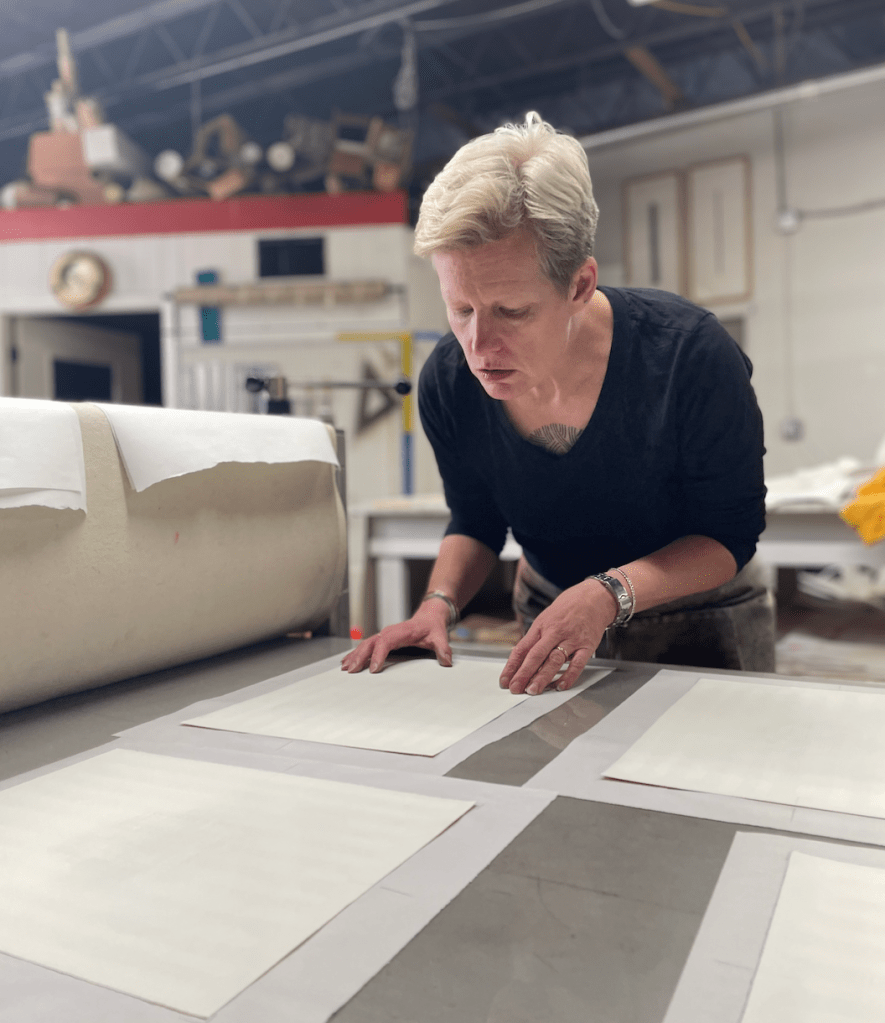
Ink, Inspiration, and a Sustainable Creative Life
Some people meticulously plan their careers. Others are born into an environment that makes their path clear. For Sarah Smelser, growing up with a father who was a professor at UC Berkeley, academia was second nature. Surrounded by intellectuals, students, and faculty, she saw firsthand the benefits of a life dedicated to education—traveling abroad, engaging in deep study, and fostering meaningful connections. It was no surprise that she gravitated toward teaching herself.
From Berkeley to Printmaking—and Beyond
Born and raised in Berkeley, California, Smelser didn’t have to travel far for her undergraduate studies at UC Santa Cruz. Her connection to printmaking was somewhat serendipitous—her uncle, a philosophy and religion professor, introduced her to a colleague named Kay Metz, who taught printmaking at UCSC. Metz saw promise in Smelser’s portfolio and fast-tracked her into advanced classes, setting the stage for a lifelong career in the medium.
After completing a year abroad in Florence, Italy, focusing on black-and-white etching, Smelser returned with a renewed passion for printmaking. But rather than jumping straight into graduate school, she took a year to work at Kala Art Institute in Berkeley, where she built a portfolio and networked with artists to help determine her next steps.
Ultimately, she landed at the University of Iowa, known for its rigorous printmaking program—and, oddly enough, the fact that they make their own ink. There, she found invaluable mentors in Bob and Kathy Glasgow, who helped prepare her for the academic job market with mock interviews, resume critiques, and career guidance.
The Teaching Path: From Junior Colleges to Tenure
Teaching wasn’t a fallback for Sarah—it was part of the plan. “My dad was a professor, and I always knew I wanted to do what he was doing,” she says. Her teaching career started with a series of stepping-stone positions: a non-tenure sabbatical replacement at the University of Wisconsin–Stevens Point, a year at Pasadena City College, and then a tenure-track position at West Virginia University. But by year three, she knew WVU wasn’t where she wanted to stay.
That’s when Illinois State University entered the picture. Eight months pregnant at the time of her phone interview, she was unable to travel for an on-campus visit. ISU delayed the search until she was able to interview in person. When her son was just a month old, Smelser and her family made the trek from West Virginia to Illinois for the final interview. In 2002, she began her tenure-track position at ISU, where she has remained ever since.
Balancing Art, Teaching, and Professional Development
Sarah describes her studio practice and teaching as two separate but complementary forces. “They fuel each other, but they’re totally different activities,” she explains. “In the studio, I crave solitude and flow. In the classroom, it’s all about engagement.”
Recognizing that not all students thrive in a social learning environment, she makes room for different types of artistic temperaments. “I try to be aware of students who, like me, need time in their own heads,” she says. “But at the same time, I push them to engage—because community is everything in the arts.”
She also stresses the importance of professional development. Through ISU’s Professional Artist Practice course (ART 350), Smelser ensures students leave with tangible skills: framing their work, building a professional portfolio, and navigating exhibition opportunities through platforms like CaFÉ. These pragmatic lessons aim to bridge the gap between artistic practice and career sustainability, reinforcing that artistic success isn’t just about talent—it’s about knowing how to navigate the professional world.
Challenges Facing Young Artists
While some obstacles remain timeless—staying motivated, handling rejection, and maintaining creative momentum—Smelser sees today’s biggest challenge as the shrinking attention span. The digital era has made it harder to sustain deep focus, a necessity in printmaking and most artistic pursuits. Add to that the lingering effects of COVID-19 on resilience and community engagement, and the path for emerging artists is undeniably steep.
She also encourages students to redefine success. “Not everyone is going to be an art superstar.” she says. “But you can still have a creative life that’s meaningful and fulfilling.” She stresses that success isn’t solely about work—it’s about building a life that allows for creativity, balance, and sustainability.
Building Stronger Connections Between Alumni and Faculty
Sarah sees huge potential in strengthening the ties between ISU faculty and alumni. “Students should never be shy about reaching out,” she says. “Faculty are there for alums, but I don’t think enough graduates realize that.” She’s worked with former students in both formal and informal ways—from writing letters of recommendation to collaborating on artistic projects—but she’d love to see something more structured, like what Normal Roots is building.
“Right now, it’s all happenstance—who you keep in touch with, who reaches out,” she says. “But a real network, something intentional? That would be incredible.”
Her message to alumni is simple: “I love you. Don’t be a stranger. I’d love to hear what you’re doing, artistic or not.”
What She Wishes Students Would Take Advantage Of
Looking back on her own education, Sarah wishes she had developed a stronger political and social conscience earlier. “I was a little tongue-tied when it came to activism,” she admits. “I envied people who had that clarity early on.” She urges students today to consider their own values and how they align with the issues that matter most to them.
She also talks candidly about how relationships can shape—or limit—opportunities. “I had a long relationship with someone who, in hindsight, really held me back. I missed out on so much because I was wrapped up in his world instead of fully stepping into my own.” It’s something she keeps an eye out for in her students, particularly young women. “I hate seeing students shrink themselves in relationships. Sometimes they don’t even realize they’re doing it.”
Advice for Artists Finding Their Way
For those feeling lost post-graduation, Smelser urges them to keep creating—even if it’s not in their original medium. “A printmaker might discover they’re an incredible sculptor,” she says. More importantly, she advises maintaining at least a “baby toe” in the creative pool. Joining critique groups, setting small artistic goals, or simply engaging with art in any form can keep the momentum alive.
She likens it to going to the gym: “Once you fall out of practice, getting back in feels impossible. The best way to avoid that? Don’t stop.” As for balancing art and life, she knows firsthand that priorities shift—especially for parents. “Your studio practice will come back to you” she reassures.
Why These Stories Matter
Sarah Smelser’s career is a testament to what happens when talent, resilience, and mentorship align. It’s proof that the creative process doesn’t end at graduation—it evolves, shifts, and sometimes circles back in unexpected ways. Whether you’re a new graduate navigating life after school or a seasoned artist reconnecting with your roots, Normal Roots is here to remind you that you have a community of artists at your fingertips. No matter how far removed you are in time or location, the connections you made at ISU don’t expire when you leave campus.
Interview by Kelsey DeGreef for Normal Roots.
 Normal Roots