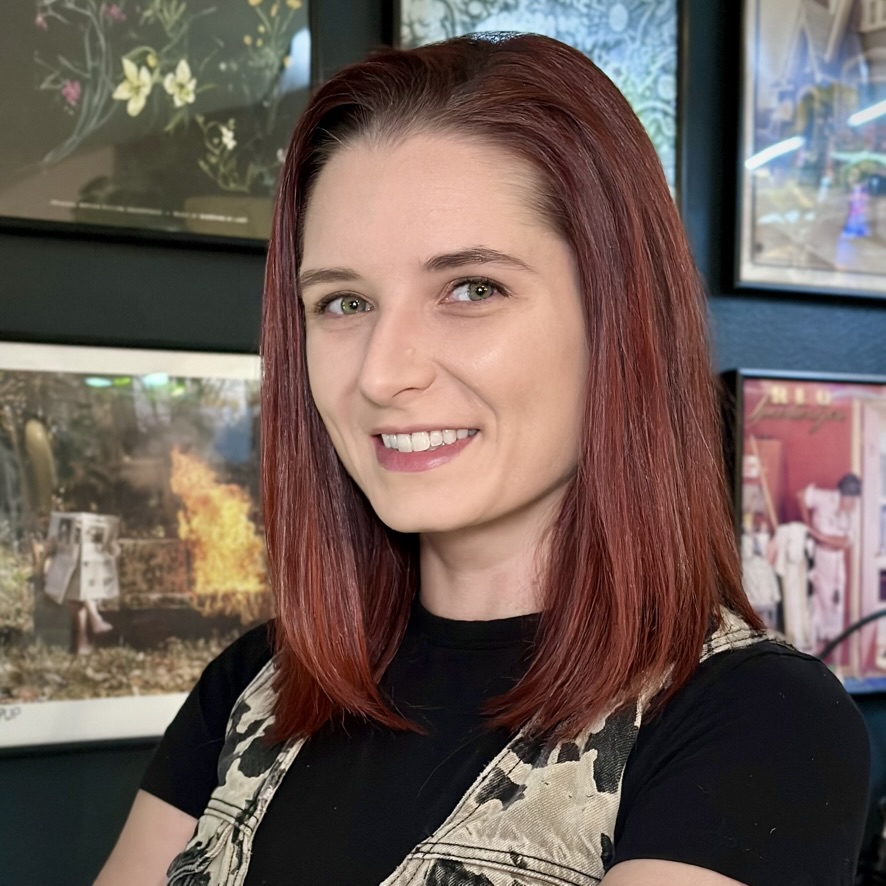
Sarah Wilson
Graphic Design + Photography ’12
Childhood Doodler to a Career in Design
In the latest Normal Roots artist interview, we caught up with Sarah Wilson—graphic designer, product designer, and creative mind behind @miller_makes_. Sarah’s trajectory from coloring on her kindergarten shoes to navigating the corporate tech world reveals how creativity can take on many forms—and how stepping away from traditional career paths can open space for new ideas to emerge.
Sarah’s creative journey started small—drawing on shoes, filling notebooks with doodles—but began to solidify during her senior year of high school in an AP Photography class. At ISU she double majored in graphic design and photography. Sarah was career-focused from the beginning. She chose graphic design and photography, not out of a clear artistic ambition, but because it felt like the most practical way to pursue a creative career. That pragmatism followed her into the workforce, where she built a career in graphic design, UX, and product design—fields that prioritize function over self-expression.
Creative Spaces Beyond 2D
During her time at ISU, she was heavily influenced by her professor Julie Johnson, who helped her recognize her strengths beyond just technical skills—emphasizing her ability to collaborate and think critically. Though focused on design, Sarah appreciated the opportunity to step outside of her discipline through art electives like integrated media and glassblowing. These courses challenged her to think beyond the two-dimensional world of graphic design and experiment with creating in 3D space. She learned to use technology like laser cutters and rendering programs to bring her artistic concepts to life, a skillset she still taps into when exploring creative projects today.
Unlike some of the other disciplines, graphic design students often worked independently rather than in a communal studio environment. This made it harder to connect with the broader creative community on campus, something Sarah now realizes she missed out on. Looking back, she wishes she had engaged more with her peers and taken advantage of the artistic networks around her.
Life After Graduation
When she graduated, Sarah expected to land a job at a big design agency, creating high-profile marketing campaigns, as that was the aspiration often emphasized in school. However, reality was different – opportunities in central Illinois were limited. Her career began at a small design firm, where she was part of a four- to five-person team handling print materials, logos, and websites. The role demanded rapid growth—pitching designs to clients, managing contracts, and balancing multiple brand identities.
Wanting more consistency, she transitioned to Wolfram, where she worked on the Wolfram Alpha project for five years. This shift introduced her to UX and product design, moving her away from purely visual work and into functional, user-driven design. From there, she joined Braze, a fast-growing tech company where she was “thrown into the deep end” of business-minded design. “It was the biggest challenge of my career,” she said, reflecting on her time there.
“Being able to take a company public, working at a startup that grew by 1,300 people while I was there—it was just massive.” Over time, her role became less about hands-on design and more about high-level vision, customer interactions, and operational strategy. “I remember just starting to feel like, ‘I can’t do this forever. There’s no way I do this forever. I don’t want to wake up in ten years and still be in this same job, just pushing the corporate machine.’” While she thrived in this environment, the demands eventually led to burnout, prompting her to step away and explore creativity on her own terms.
Stepping away from work entirely for the past year and a half, she’s allowed herself to follow curiosity wherever it leads. Printmaking, sewing, bleaching thrifted clothes—whatever calls to her that day. The projects may not always feel productive, but they’re tangible reminders that creation itself is worthwhile, even without an audience or paycheck. “It’s not a waste of time,” she says. “You’re investing in yourself. You’re letting yourself explore and create.”
How She Defines Success Now
Sarah’s perspective on success has evolved significantly since her early career. While she once equated it with working at a prestigious agency and producing high-profile work, she now sees stability and financial independence as key factors. “Being able to have a design job and make 200K—that’s pretty great,” she says. But beyond financial security, she values the ability to work on products with global reach and constantly evolve her product design craft.
Power of Collaboration
One thing Sarah took away from her time at ISU was the importance of collaboration and critique. Graphic design classes often involved multiple rounds of feedback, which taught her to refine her ideas and take constructive criticism in stride. This skill has continued to serve her in professional settings, where iteration and teamwork are key to producing great design work.
Throughout her career, collaboration has played a significant role in shaping Sarah’s approach to design. From client feedback to interdisciplinary teamwork, she has found that the best ideas often come from bouncing concepts off others. “If you’re not collaborating, you’re probably not doing a good job,” she says. Even in independent projects, she values outside input and enjoys engaging with other creatives to refine her work.
Advice for Emerging Creatives
Sarah encourages those starting their creative careers to stay flexible and open to unexpected opportunities. “Don’t get too caught up in what you think your career should look like,” she advises. “Be willing to pivot, learn new skills, and take on unexpected projects—you never know where they’ll lead.” She’s learned that the most fulfilling career paths aren’t always linear, and the willingness to adapt can open doors in surprising ways.
One piece of advice that stuck with her came from Julie Johnson, a professor at ISU: “You may not be the best designer, but people will want to work with you, and that will take you far.” For Sarah, this was a game-changer. It reassured her that success wasn’t solely about being the most talented designer in the room—it was about being collaborative, adaptable, and someone others trusted to get the job done. That mindset helped her push past imposter syndrome and build confidence in her abilities beyond artistic skill alone.
On the flip side, the best advice she has ignored? Learning to tune out toxic workplace criticism. Early in her career, she worked in environments where feedback was more about control than constructive growth. Over time, she learned to recognize the difference—understanding that not all criticism is valid and that trusting her own instincts was just as important as external feedback. Letting go of the need to internalize every negative comment helped her grow as a designer and a professional.
Reframing Creativity: The Joy of Making
Despite spending more than a decade in the design world, Sarah does not primarily identify as an artist. “I think of myself as a creative more than an artist,” she shared, reflecting on how her work has always been driven by constraints, function, and collaboration rather than self-expression. Her design work isn’t “the kind you frame and hang on a wall”—but that doesn’t make it any less valuable.
In a world that often equates creativity with output and success with visibility, Sarah’s story reminds us that creativity isn’t always loud or obvious. It can live in the quiet, in the process of trying, failing, and trying again. It can show up in the way we arrange our days, not just in the things we make.
As Normal Roots continues to foster connection and collaboration among ISU artists, Sarah’s journey is a reminder that the most valuable creative work isn’t always the work that gets seen.
Interview by Kelsey DeGreef for Normal Roots.
 Normal Roots