Tim kowalczyk
MFA Ceramics ’11
Memory, Clay, and the Cardboard Illusion
Tim Kowalczyk didn’t plan on being a ceramicist. In fact, he didn’t even plan on going to college. But through a series of unexpected turns—shaped by family influence, a persistent artistic curiosity, and a bit of competitive spirit—he found himself immersed in the world of ceramics, making work that turns the ordinary into something extraordinary.
His Path to Ceramics
Growing up in Morris, IL, Tim was surrounded by creativity. His mother worked with stained glass, and his father had an innate ability to build anything he set his mind to. But it was his older brother, a naturally skilled artist, that set a creative bar Tim admired. While he always had an interest in making things, it wasn’t until college that he truly found his medium.
He attended Joliet Junior College because it was affordable, close to home, and provided him with a creative outlet. Having an interest in sculpture early on led him to start on that track. Encouraged by his friends who were heading off to four-year universities, Tim applied and was accepted at Southern Illinois University, Carbondale (SIUC). That’s when he took an introductory ceramics course—mostly as a requirement—but quickly found himself captivated by the material.
Eventually, he found himself working under the mentorship of graduate assistants who saw potential in his work. They fed him reading materials beyond his level, unknowingly setting the stage for what would become his signature style. It was at SIUC that he really began to embrace ceramics as more than just a medium—it became the foundation of his artistic voice. His early sculptural instincts carried over, and he started to develop the ideas that would later define his work.
Finding Form in Function
Tim’s early work was largely sculptural, deeply influenced by his grandfather’s passing and the physicality of moving boxes filled with memories. With a family history in the cardboard industry—his father and grandfather worked in a factory making cereal boxes—Tim became fascinated with the visual language of packaging. When a visiting artist dismissed his idea of making a cube out of clay as “too difficult,” it ignited a stubborn determination. That moment shaped his career.
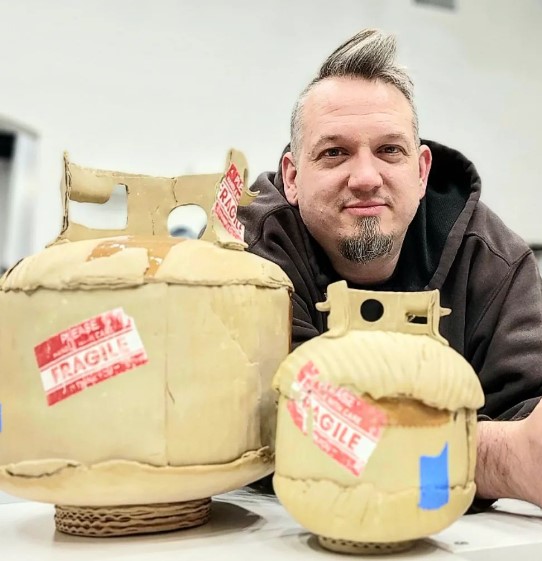
In his graduate years at Illinois State University, he honed his unique aesthetic: ceramic objects that mimic cardboard so convincingly that viewers often do a double take. ISU’s rigorous program forced him to refine not just his technical skills but also his conceptual framework, helping him transition from an artist exploring material to one mastering it.
The Breakthrough Moment
Post-graduation, Tim juggled adjunct teaching with creating art, using his home studio in Minonk, IL. The real turning point came in 2016, when a student casually uploaded an image of Tim’s work to Reddit. Within hours, his ceramic mugs designed to look like crushed cardboard had gone viral. Suddenly, orders flooded in, and galleries took notice. Companion Gallery, Black Book in Denver, and others began representing his work, and collectors started paying attention.
Balancing Art, Teaching, and Family
While his ceramics career soared, Tim kept one foot in education, working as a high school art teacher. The stability of teaching provided insurance and structure, but his real passion remained in the studio. His home setup allowed him to balance family life, sneaking in studio time between school drop-offs and late-night creative sessions.
The blend of functional ceramics and conceptual sculpture continues to drive his work. His pieces are equal parts familiar and deceptive—objects that look like disposable packaging but are actually finely crafted ceramics. This contrast between expectation and reality keeps audiences engaged and has cemented his place in the contemporary ceramics scene.
The Philosophy of Making
Tim’s artistic approach is deeply rooted in playfulness and experimentation. He doesn’t see failure as a setback—it’s just another step in the process. Whether it’s smashing a piece to see how it reacts or repurposing discarded ideas into something new, he values exploration over perfection.
His studio mantra? “I make stuff out of stuff that looks like other stuff.” It’s a deceptively simple statement that captures his entire philosophy—transforming the mundane into something thought-provoking. He embraces the absurdity of his work, leaning into humor and spontaneity while maintaining a meticulous level of craftsmanship.
He also sees value in keeping the audience engaged. His backstory—how he came to make ceramic cardboard—is something he’s learned to embrace. “People want to connect with what you do,” he says. “Once they understand the story, they invest in it.”
The Role of Collaboration
Collaboration plays an essential role in Tim’s creative practice. Over the years, he has worked with graffiti artists, painters, and fellow ceramicists, constantly pushing the boundaries of what his work can become. Some collaborations happen naturally, others take years to develop—like a set of ceramic trees he was sent three years ago, only recently finishing them when the right idea clicked.
“I like the unpredictability of collaboration,” he says. “It’s like firing in a wood kiln—you put something in, and you hope for the best.” By stepping outside of his comfort zone and working with others, he continuously evolves his practice and discovers new techniques.
The Hard Truths About Being an Artist
Despite his success, Tim is quick to highlight the misconceptions people have about making a living as an artist. Many assume it’s easy, that artists just sit around waiting for inspiration to strike. The reality? It’s constant work—managing social media, answering emails, packing and shipping pieces, applying to shows, and maintaining a studio practice.
Even within the art world, he’s observed how different disciplines are valued differently. Glass artists, for example, often command higher prices than ceramicists, and 2D art tends to be more widely accepted in galleries. But instead of letting that discourage him, he uses it as motivation—challenging himself to push the boundaries of what ceramics can do.
What’s Next for Tim Kowalczyk?
Today, Tim continues to experiment, always looking for the next challenge. He’s currently tackling teapots—one of the most technically difficult forms in ceramics—despite never having made a fully functional one. “I don’t need to, but now it’s a challenge,” he says with a grin.
He’s also taking on more collaborative projects and exploring direct sales rather than relying solely on galleries. His work remains rooted in curiosity, humor, and a relentless drive to make the everyday extraordinary. From an uncertain start in junior college to a viral moment that transformed his career, Tim Kowalczyk proves that sometimes, the best plans are the ones you never made.
To wrap up our time with Tim, we threw a few rapid-fire questions his way:
Is there someone in your creative network who deserves more recognition?
“Too many people. Let’s go with some special effects people. Mike Reagan @mikefx and Henrik Van Ryzin @vantiki—they’re both amazing.”
What’s a project or idea you haven’t made yet that you can’t stop thinking about?
“I always write things down as a list. When I have an empty moment, I go to that list.”
If you could change one thing about the art world, what would it be?
“Accessibility. More opportunities for viewing, participating, and teaching.”
What’s the best piece of advice you’ve ignored?
“Someone once told me to try 2D, but I ignored it for a long time. Then I tried it, and I really liked it.”
How do you define success for yourself now versus when you started?
“Success used to be based on others’ opinions. Now, it’s about making myself smile or giggle—like with the Cadbury Creme egg mug.”
What’s the weirdest or most unexpected reaction someone has had to your work?
“I’ve seen people shake their heads and leave, but when they find out it’s ceramic, they jog back in to get a closer look.”
If you could collaborate with any artist, living or dead, who would it be?
“Jean-Michel Basquiat. I love his playful style.”
What’s your go-to studio snack or drink?
“Coffee, of course. And for snacks, I’m all about Aldi Fruit Rounds.”
 Normal Roots