
Timothy Winkleman-Milling
BFA Painting ’12
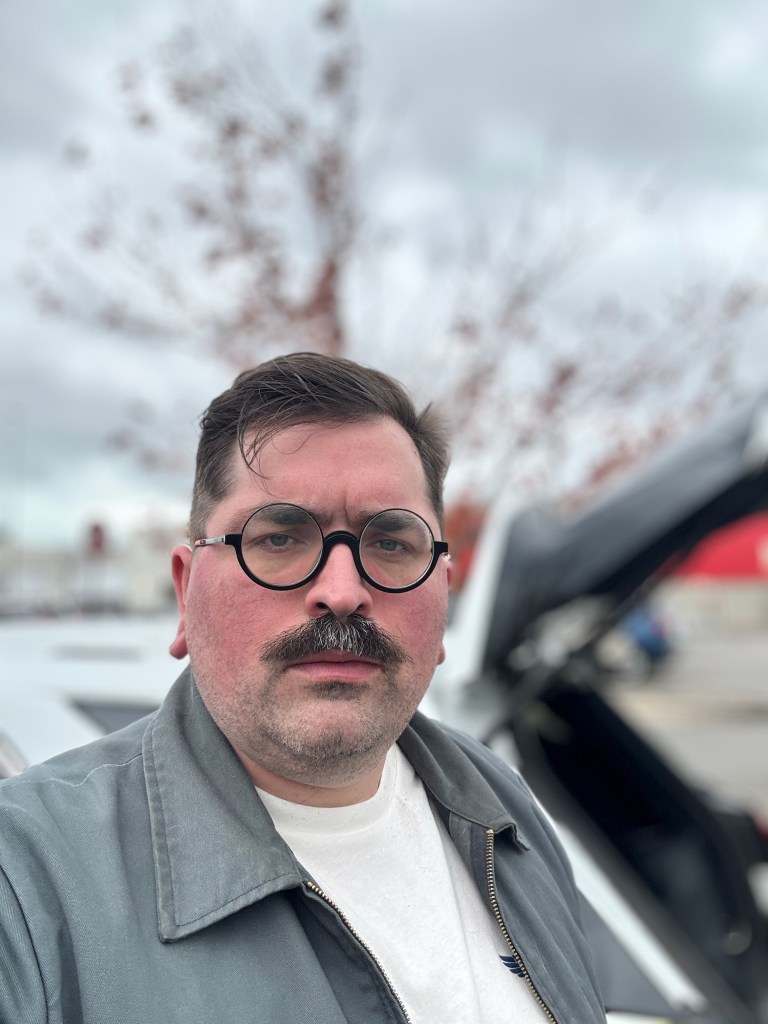
Rediscovering the Urge to Create
Timothy’s earliest memory of art is attached to family visits to the Art Institute of Chicago, where his grandfather, an amateur painter, introduced him to Impressionist works. A particular Renoir painting etched itself into Tim’s memory—a symbol of calm in an otherwise unstable childhood. “I always had a little picture of it,” he recalled. “It just holds a lot of memories.”
Art wasn’t always a constant presence in Tim’s life. It returned in high school, when he discovered it as a way to gain control and understanding amid chaos. “You create the space where you feel some power,” he said. “It’s not like the outside world—you can actually shape something.”
Drawn to that sense of agency and discovery, Tim chose to study at Illinois State University, initially eyeing art education but ultimately gravitating toward studio work. He graduated in December 2012 with a BFA in Painting and a minor in Art History, deeply influenced by the community he found there.
Learning to Let Go of the “Art Superstar” Myth
“I don’t even think I think of myself as a painter anymore.” Timothy Winkelman doesn’t say that with regret. It’s more of a thoughtful shrug—a reflection on how identities shift, especially in the years after art school. Graduating from Illinois State University in December 2012 with a BFA in Painting and a minor in Art History, Tim was part of a tightly knit studio culture that made space for exploration, critique, and belonging. But post-graduation life hit hard and fast.
“Literally the day I graduated, I packed up a moving truck and moved to Chicago,” he said. He was eager to leave behind the college-town inertia, propelled by the hope of an internship at the 65 Grand and a continued connection to creative work. Instead, he found himself working in food service to get by. The shift was jarring: “Going from having this huge community to being alone in your studio space all the time—that was the hardest thing to really adjust to.”
From the Classroom to the Real World (and Back Again)
Like many grads, Tim wrestled with expectations. “You see people going to grad school or teaching, and it’s like, not everyone can do those things.” He applied to residencies, one of which accepted him by mistake, then revoked the offer. “It felt so defeating,” he recalled. “It was something I could have used to really connect with people.”
Still, he kept going. He eventually moved to New York after being accepted to a graduate program in Performance Studies at Pratt. But high tuition and the cost of living forced him to defer and eventually abandon the plan. “It was another really hard thing,” he said.
Tim later completed an online master’s in media design and branding through Full Sail University, but again found that the program wasn’t quite aligned with his professional needs. “It just wasn’t where I needed to be at that point in my life,” he said.
Over the past decade, he’s made a living managing coffee shops, all while grappling with what it means to sustain a creative life outside of traditional frameworks. Often identifying with the role of the observer, a perspective shaped by a lifelong habit of reflection, Tim has leaned into a Camus-like acceptance of the grind. “It’s a bit Sisyphean,” he joked during the interview, referring to the cyclical nature of making art with no guarantee of recognition. “But there’s meaning in the push.”
Art as a Quiet Companion
“There was a point where I didn’t draw anything for maybe a year and a half,” Tim said. “And I was just kind of at that point where I was like, maybe that’s over, and that’s OK.” But eventually, the need to create came back. Slowly. Naturally. “It just kind of came back one day where I was like, I just really want to do this again,” he said. Art became a personal tool, a means of processing life—not necessarily something to show or sell.
“The idea of having an art practice is still super important to me, because it’s not about showing it. It’s just about the urge to create things.” Tim began exploring poetry and writing, sometimes pairing it with visual work. “Sometimes the painting is more important than the words, sometimes it’s the other way around,” he said. During the pandemic, he and his husband even taught themselves to sew. He laughed about the struggle of working in three dimensions, remembering a pillow project from 3D Design class at ISU: “I can do it, but it’s so hard.”
Process Over Product
Tim doesn’t hold tightly to the work he makes. “I’ve never been super precious about the art that I make,” he said. “It’s not about the objects. It’s not about preserving them. It’s about the process.”
Much of his art lives on the walls of his apartment. It’s a way to trace connections, to decorate with meaning, to exist surrounded by his own evolving sense of self. “I like to be a person who’s fascinated by the world,” he said. That sense of curiosity often sparks new creative explorations. “One year, I got really into the number 3, numerology, angel numbers… and I made drawings about it, wrote about it, and then moved on.”
He’s learned to see value in transient obsessions and unpolished output. “I’m just using these tools that I’ve built up to understand the world a little bit better.”
Community, Connection, and the Artist’s Role Today
One of the biggest losses after art school was the critique space—the environment where people could talk deeply, constructively, and even critically about creative work. “That’s the thing maybe missing for a lot of people,” Tim said. “Someone willing to feel safe enough around each other to say, ‘Hey, I don’t get it.’”
He sees a lot of potential in Normal Roots to bridge that gap. “I really like the idea of meetups where people bring their stuff and just talk about it,” he said. “Not in a critique like ‘this sucks,’ but a regular studio visit.” Even virtual gatherings could be valuable. “Just a meeting where someone can present their work. Like a little artist talk. Not everyone has to do it, but it could be a space to share, to reconnect.”
Tim also emphasized how strong the ISU connection still feels, even years later. Noting that even feels a connection to the people that he only had one class with, saying that he’d “feel comfortable sharing work with them.”
Rethinking Success and Embracing the Long View
Tim is honest about how his idea of success has changed. “I used to be so determined to be one of those people still making work and making money off of it. And if I didn’t, then I wasn’t an artist anymore.” But over time, he’s let go of the label. “I don’t know if I consider myself an artist as much as a person who creates. A person who works through things using these tools.”
That mindset shift is part of what makes Tim’s story resonate. It’s not about reaching a peak. It’s about staying in motion. About listening to the part of yourself that wants to respond to the world. Often describing himself as an observer, he benefits from a perspective that has carried him through uncertainty, reinvention, and the slow burn of creative rediscovery. Like Camus’ Sisyphus, Tim pushes the boulder of his practice uphill not because of promised reward, but because he’s found purpose in the effort itself.
“I make it, it’s out there, and it’s not my problem anymore,” he said. “I’ve put it into the universe. Now I can move on.”
Interview by Kelsey DeGreef for Normal Roots.
 Normal Roots