
Tyler Lotz
Director Wonsook Kim School of Art
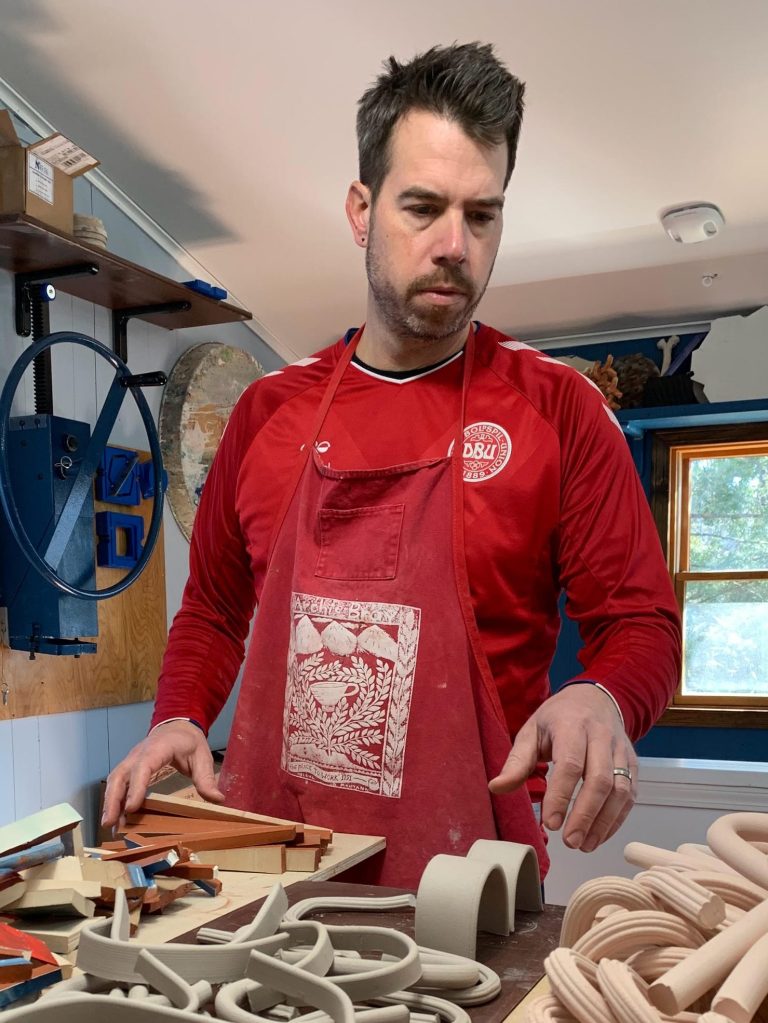
Transformation, Leading, and Lifting Others
When Tyler Lotz talks about the path that led him to ceramics, there’s a clear throughline: curiosity, perseverance, and a deep love for creative problem-solving. When Lotz first started college, he was on track to study forensic science. But somewhere between chemistry labs and ceramics wheels, he found his way into the arts — and never looked back. Now serving as Director of the Wonsook Kim School of Art at Illinois State University, Lotz reflects on his twenty-year teaching career, his artistic evolution, and the importance of taking opportunities when they come.
From Chemistry to Ceramic
In high school, Tyler split his time between chemistry and ceramics, sneaking out whenever he could to spend more time at the wheel. It was a summer at the now-defunct Pennsylvania Governor’s School for the Arts that cemented his love for clay, showing him that “these are my people.”
Still, he started college as a chemistry major at Penn State, thinking forensic science was his future. “I was interested in chemistry and art,” he said. But higher-level math proved a hurdle, and he pivoted during his sophomore year toward his other love: ceramics. “Fortunately, ceramics uses a lot of chemistry,” Lotz explained. He found a new way to apply his scientific mind—this time, to glaze formulas and firing techniques instead of lab experiments. “I was able to parlay that knowledge into a more aesthetic, creative point of view.”
Switching to ceramics was more than a change in major; it was the beginning of a career he would shape with intention. Thanks to inspiring mentors and an affinity for learning through making, his teaching instincts took shape early. “Penn State happened to have one of the top ceramic programs in the country, and I didn’t even know it. The moment I switched, I knew I wanted to teach at the college level” he said. Lotz went on to pursue his MFA at Alfred University, another leading ceramic program. After that, he worked at Ohio State University, gaining crucial teaching experience. He worked as a tech and taught classes in drawing, metal casting, and ceramics. “It was a great experience for me to be thrown into that,” he said. It was the confidence building experience that he needed to figure out that he really could teach anything.
Building a Home in the Midwest
In 2002, Tyler and his wife Erin Furminsky moved to Bloomington-Normal so that he could teach ceramics at Illinois State University (ISU). He openly admits that the town wasn’t initially on his radar, but over time, it became home. “Ten years flew by, and before I knew it, this was the longest place I’d ever lived. I was from Illinois because I wasn’t really from anywhere else,” says Lotz, whose upbringing included several cross-country moves due to his father’s Coast Guard career.
It also became the place where he raised a family, developed a rigorous studio practice, and continues to help shape generations of art students.
Balance and Leading with Curiosity
Lotz stepped into the role of Director three years ago, a position he hadn’t originally sought out. “I think I even said at one point I’d never be an administrator,” he laughs. But when the opportunity arose, he realized he was ready for a change—and that he had developed a deep passion for the institution that had supported his teaching career for two decades. “I had this slow-build realization that I really care about this place,” he says. “It’s allowed me to teach what I want to teach, and though I may not have planned to stay in Bloomington-Normal, I grew to love it.”
The move to administration hasn’t been without its trade-offs. Lotz now rarely teaches a full class, though he stays connected through independent studies and student mentorships. Balancing his directorial duties with his own studio practice has been a challenge. “Right now I’m trying to carve out time for a new tableware line I’m developing,” he says. “It’s hard to juggle, but the work is still there, waiting.”
The Art of Showing Up
One of Lotz’s biggest lessons? Don’t hesitate when opportunities arise. Early in his career, he met a Chicago gallerist at SOFA Chicago who casually invited him to bring work by. Instead of brushing it off, he took a chance. “I called her up, said I had a car full of work, and she told me to come by. I unloaded my car, and within minutes, she asked, ‘So, when do I want to have your show?’” He laughs at the absurdity of it now, knowing that stories like that are rare, but he still believes in the lesson: “When somebody asks you to do something, do it. Don’t talk yourself out of it.”
That same drive is what he encourages in students today. When asked what he wished more students would take advantage of while in school, his answer is simple: “Studio time.” With nearly 24/7 access, he sees too many students missing out on the chance to develop their practice simply because of distractions. “Scrolling Instagram doesn’t get your work made,” he says.
Shifts in the Art World
Reflecting on how the art world has shifted since he began teaching, Lotz points to the rise of social media. “It’s completely upended everything. People can build entire careers online now,” he says. While this has broken down traditional gatekeeping in the gallery world and created more opportunities, especially for underrepresented artists—it has also introduced new challenges. “There’s more visibility, but also more noise. The biggest challenge for young artists today is finding their own voice in a world where everything is already out there.”
Another shift? The intersection of digital tools and traditional craft. Lotz himself embraced 3D modeling and digital fabrication techniques after a workshop at Anderson Ranch, leading him to develop a Digital Clay course at ISU. He believes these skills are crucial for the next generation of makers.
Pay it Forward
If he could give one piece of advice to his former students, it would be to use their knowledge to lift others up. “Find ways to give back—whether that’s mentoring younger artists, sharing opportunities, or just supporting each other. Teaching isn’t just about making a living; it’s about passing on the same excitement and encouragement that helped you along the way.”
And for those who feel lost after graduation? His answer is blunt but honest: “If you want to make art, make art. If you’re waiting for the perfect conditions, you’ll be waiting forever.” While he does acknowledge that access to materials and space can be a challenge, he encourages alumni to seek out community studios, residencies, and workshops. “There are ways to make it work if you want it badly enough.”
Looking Ahead
Though Lotz’s administrative role keeps him busy, he still sees himself as an artist first. He continues to develop new work often exploring the intersections of function, form, and technology.
He is also passionate about fostering connections between students, faculty, and alumni. Whether through critique sessions that bring BFA and MFA students together or encouraging alumni to return and share their experiences, he believes these relationships strengthen the artistic community. “Having more people knowledgeable about what’s going on in the field to engage in dialogue with is really important,” he said.
And as for success? His definition has evolved. “It’s pretty simple: If you like what you are doing, that is success.”
For now, he leaves artists—emerging and established—with this final thought: “If you have an opportunity to help someone else break into the art world, take it. The more we support each other, the stronger our community becomes.”
Interview by Kelsey DeGreef for Normal Roots.
 Normal Roots